Every batch of arrows has variation. Straightness tolerances are published, but spine consistency, nock seating, and insert concentricity are not. At 20 yards with fletching, most of that variation is invisible. At 40 yards bare shaft, it is not. An arrow with a rotational preference — a spine node that sits in the wrong orientation relative to the string — will land away from the group every time. The fletching will eventually mask it, but it will show up again when you switch to broadheads, or when conditions are difficult, or when the group that was tight at 20 yards opens up at 60.
This process finds those arrows before you invest any work in them, and usually fixes them without pulling them from the batch at all.
Group tuning vs. bareshaft group tuning
Regular group tuning works from the bow side. You shoot fletched arrows and make small adjustments — rest position, cam lean — until the cluster tightens. You are adjusting the bow to fit the arrows’ average tendency. The fletching is correcting arrow flight on every shot, which means you are reading the output of the correction system, not the underlying mechanical behavior of the arrow. It is approximate. You are getting close to the oscillation plane alignment without ever actually seeing it.
Bareshaft group tuning works from the arrow side, and it is a different level of precision entirely. Without fletching, the arrow cannot hide its rotational preference. Where the shaft lands at 40 yards is a direct expression of how its spine node is oriented relative to the bow’s dynamics on that shot. When you rotate the nock and the arrow moves into the group, you have found the oscillation plane alignment — not estimated it from a tightened cluster of corrected arrows. You found it directly.
Group tuning is a reasonable field approximation. Bareshaft group tuning is the precise method. Done correctly here, it makes group tuning from the bow side unnecessary.
Setting the bow
Before shooting, set the bow to a slight, deliberate, consistent bias. High right is a common choice, but the specific direction does not matter much. What matters is that it is minor and that it is repeatable: a well-behaved arrow should land near the same spot every time. A perfectly centered setup is harder to use as a reference because random shot variation from grip or form can scatter arrows in any direction, making it difficult to distinguish the bow's contribution from the arrow's.
A consistent slight bias gives you a stable reference point. An arrow that lands with the group is oriented correctly for this bow. One that doesn't is telling you something.
Why 40 yards
Twenty yards does not separate arrows usefully. The aerodynamic forces that express a rotational misalignment as lateral displacement have not had enough distance to move the bare shaft meaningfully off center — the variation compresses into a region that looks like normal shot scatter. At 40 yards those forces have had time to work, and small rotational differences in nock position express as clear spatial separation you can act on.
Past 40 yards the test breaks down for a different reason. A bare shaft in off-axis flight doesn’t drift linearly — the off-axis angle compounds on itself with distance. An arrow that lands 6 inches off at 40 yards may not land on the bail at all at 50. If a bare shaft with an intentional bias does hit the target at 50 yards, it almost certainly flew unusually straight — meaning the bias wasn’t expressing, which is the opposite of what you need to read for tuning. Forty yards is the distance where the signal is strong enough to act on and still contained enough to be legible.
Diameter limit
This test works for 6.5mm shafts and smaller. Larger diameter arrows make the method too sensitive to be useful — the aerodynamic effect of a larger surface area amplifies any small angular deviation, so a minor bare shaft orientation difference produces a massive POI shift. The signal-to-noise ratio inverts: what should be a readable small offset becomes an extreme scatter that tells you nothing actionable.
Shooting a large-diameter shaft bare at 40 yards is also practically difficult. A 27-series aluminum bare shaft at that distance is hard to get to the target cleanly, and when it does arrive, the high aerodynamic drag of the large surface area tends to self-stabilize the arrow in flight — meaning the flight is too straight to show spine variation. The mechanical signal you are trying to read gets suppressed by the aerodynamic behavior of the shaft itself.
The test could in principle be done at a shorter distance with large-diameter arrows, but it is not worth adapting. Large-diameter shafts are primarily used for indoor shooting, and for indoor setups, bareshaft paper tuning followed by DIAG tuning is a more direct method and produces cleaner results. Use this bareshaft group test for small-diameter outdoor setups. Use paper and DIAG for large-diameter indoor setups.
Shooting the batch

Mark or number every arrow before you start — the nock end, so you can track which is which without picking them up. Shoot every arrow at the same target, same distance, with the same full-draw position and grip. The goal is to build a reference group and identify which arrows are not in it.
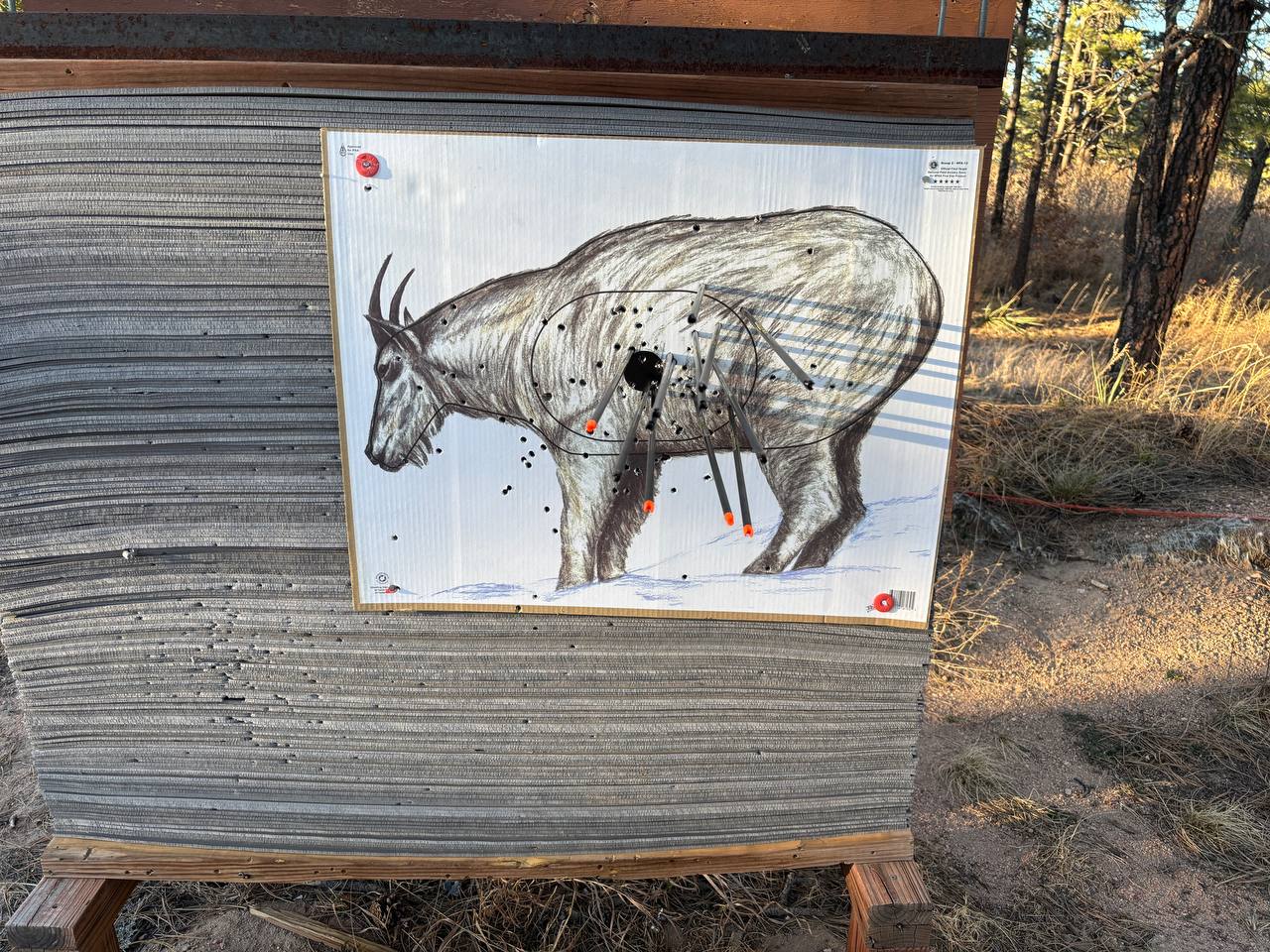
After the first round, look at the distribution. Most arrows will cluster. Any that land noticeably outside that cluster — more than a few inches at 40 yards — are candidates for nock rotation before you consider pulling them.
Nock rotation: fix before you pull
A flier's first intervention is not removal — it is nock rotation. Pull the arrow, rotate the nock one index position, reshoot. If it lands with the group, the arrow is fine; the spine node just needed a different orientation relative to the string. Index it again if needed. Most apparent fliers resolve this way.
This is the core of the process. The nock index controls which face of the shaft is presented to the rest and string on every shot. An arrow's spine is not perfectly uniform around its circumference — there is a stiff plane and a weaker plane, and the nock determines which one is loaded during the power stroke. Rotating the nock changes the loading geometry. When you find the rotation that puts the arrow in the group, you have found the orientation where that arrow's spine node aligns with your bow's dynamics.
Only pull the arrow if it refuses to group at any nock orientation. That arrow has something other than a rotational problem — a bend, a poorly seated insert, or a spine measurement genuinely outside tolerance.
Grip sensitivity
This is the most frustrating part of the process, and it is worth understanding before you start. Bare shafts at 40 yards are acutely sensitive to grip variation. A slight change in where your hand contacts the grip — a millimeter of lateral shift from one shot to the next — will move a bare shaft several inches at the target. Fletched arrows at the same distance are largely indifferent to grip variation because the fletching corrects it. Bare shafts are not.
Some of the scatter you see on the target is you, not the arrows. Slow down. Shoot with a deliberate, repeatable grip every time. If a whole group moves between rounds, that was your grip. If one arrow moves while the rest hold position, that is more likely the arrow. The discipline required here is real, and it is part of why this test is useful — it makes you shoot carefully enough to get honest data.
One practical aid: install a 30-inch front bar before running this test. A long front bar exaggerates any bow movement at the shot and makes torque visible that a short bar or no bar would hide. Watch the bar through the shot — if it drifts left or right on release, that is grip torque being applied. Use the bar as a directional gauge. Once you can see that your grip is not rotating the bow on each shot, you have eliminated the largest source of noise in the test.
After the session
Arrows that grouped cleanly — or that rotated into the group — go to fletching with their nock orientation set. Arrows that refused to group at any rotation are practice arrows. You have saved yourself the time and materials of fletching them, and more importantly, you have saved yourself from discovering the problem at 60 yards during a round that matters.
When you fletch, the nock orientation you confirmed here becomes the reference. Don't disturb it.