Three systems, not one
The mainstream advice on peep sizing says: size your peep so you see the scope housing as a perfect circle centered inside the peep opening — the "circle-in-circle." Every arrow lands in the same place as long as those circles are concentric.
This advice is coherent. It is also built on a hidden assumption that is frequently false, and it is not the only viable system. There are three distinct aiming configurations a compound archer can use, each with different error properties and different requirements.
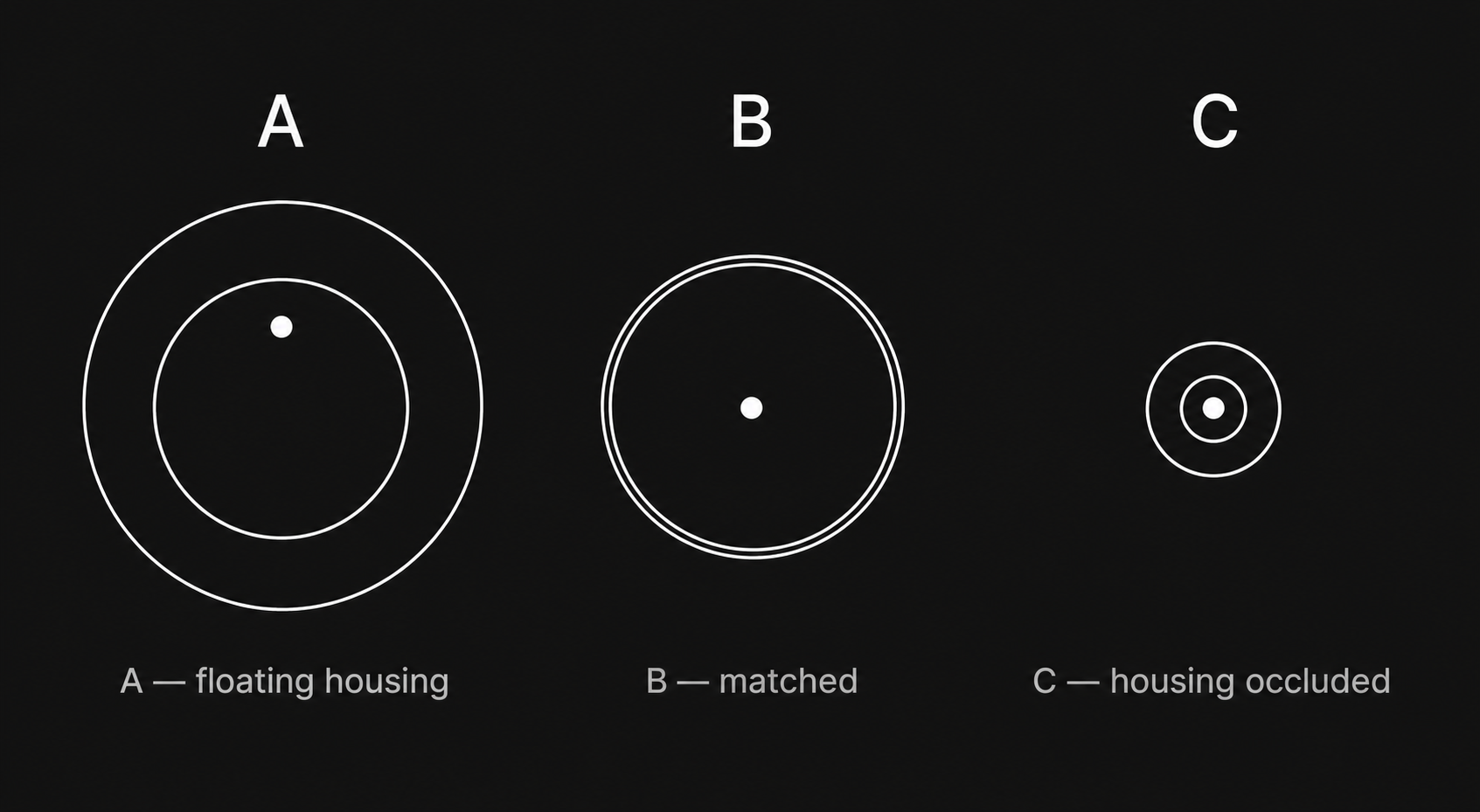
System A — Peep larger than the housing. The mainstream approach. You see the housing as a circle floating inside the peep. You center the housing in the peep, then place the pin on the target.
System B — Peep matched to the housing. The peep inner diameter is sized to just fit the housing outer diameter. The two circles are concentric by definition at correct anchor. Any anchor drift shows immediately as the housing clipping the peep edge.
System C — Peep smaller than the housing. The housing outer edge is outside the peep frame entirely and invisible in the sight picture. You see only the peep circle and whatever the scope shows through it — the inner aperture or light ring, the pin, and the target.
The choice between them is not just preference. It determines what your sight picture can and cannot tell you about your anchor.
The hidden assumption in Systems A and B
Both A and B use the housing outer edge as a centering reference. This only works if the pin is centered inside the housing — meaning when the housing is centered in the peep, the pin is also centered relative to the peep, and the entire reference chain is aligned.
In practice, the pin is often not centered in the housing. On a compound bow, windage adjustment moves the entire housing left or right — the pin stays in the same relative position within the housing. Elevation is different: on multi-pin sights, individual pins are adjusted vertically within the housing to set different yardages, and none of them sit at the housing's geometric center. Manufacturing tolerances compound this further. A multi-pin scope dialed for actual yardages will have pins distributed across the housing face, none of them centered.
When the pin is off-center in the housing, centering the housing in the peep produces a sight picture where the housing looks perfect and the pin sits somewhere other than center. The archer now has two references giving different information. Most archers resolve this unconsciously by ignoring one — usually the housing — which means the housing was never actually doing useful work.
System C sidesteps this entirely. The housing is not in the sight picture. There is no conflict to manage.
What the gap costs at distance
The key variable is the physical gap between peep diameter and housing outer diameter. Any anchor inconsistency that moves the peep by less than half that gap produces a sight picture that looks fine — the housing floats inside the peep without clipping an edge, nothing signals the drift. That undetected movement at the peep translates directly to a miss at the target: the further the target, the larger the miss for the same amount of drift.
The table below shows how that plays out at real distances. A 1/8″ gap means the peep is 1/8″ wider in diameter than the housing outer edge.
System B drives that gap toward zero — catching drift almost immediately. System A accepts a larger gap, and the table shows what that costs.
| Diameter gap (dpeep − dhousing) |
20 yd | 40 yd | 60 yd |
|---|---|---|---|
| 1/32″ (0.031″) | 0.45″ | 0.90″ | 1.35″ |
| 1/16″ (0.063″) | 0.90″ | 1.80″ | 2.70″ |
| 3/32″ (0.094″) | 1.35″ | 2.70″ | 4.05″ |
| 1/8″ (0.125″) | 1.80″ | 3.60″ | 5.40″ |
| L = 25″ sight radius. Values are maximum undetectable anchor error in Systems A and B. Error scales linearly with distance and gap. | |||
Applying the budget: hitting the X at 20 yards
The missmax formula runs in both directions. Given a target score zone, you can solve for the maximum physical peep drift that still keeps the arrow inside it. For a 20-yard indoor target, the X ring is approximately 3/4″ in diameter — a radius of 0.375″ from center. That is your entire error budget.
Working backwards from the X ring: at 20 yards with a standard 25″ sight radius, the X allows only 0.013″ of total lateral drift at the peep before the arrow lands outside it — left/right or top/bottom combined, not each direction independently. Expressed as a fraction of the peep's radius, this tells you how centered the pin must stay on every shot:
| Peep diameter | Peep radius | X budget (0.013″) as % of radius |
Meaning |
|---|---|---|---|
| 1/8″ (0.125″) | 0.063″ | 21% | Pin must stay within central fifth of the opening |
| 3/32″ (0.094″) | 0.047″ | 28% | Pin must stay within central quarter of the opening |
| 1/16″ (0.063″) | 0.031″ | 42% | Pin may drift to nearly the inner half of the opening |
| L = 25″ sight radius. D = 20 yards (720″). X radius = 0.375″. Smaller peep → larger fraction of opening available before X is missed. | |||
A smaller peep is more forgiving in this sense: the same 0.013″ physical drift budget occupies a larger share of the opening, so the pin can move proportionally further before the error leaves the X. This runs counter to the intuition that a smaller hole is harder to aim with. The difficulty is acquisition, not precision — once the pin is roughly centered, a smaller peep gives it more proportional room to float while still scoring.
A worked example: 25% float
Suppose the pin wanders to 25% of the peep’s radius away from center — a modest, plausible float for an archer who is “roughly” centered but not precise. The estimated miss at 20 yards:
| Peep | δ (25% of radius) | Miss at 20 yd | Result |
|---|---|---|---|
| 1/8″ | 0.0156″ | 0.45″ | Outside the X — clipping the 10 ring |
| 3/32″ | 0.0117″ | 0.34″ | Barely inside — 90% of X radius consumed |
| 1/16″ | 0.0078″ | 0.23″ | Comfortable X — 60% of radius used |
| L = 25″, D = 720″. X radius = 0.375″. “25% float” means the pin drifts one-quarter of the peep’s radius from optical center. | |||
There is a visual trap embedded in this. Looking at a 1/8″ circle, 20% of the radius seems like a small, manageable center zone — the kind of thing a disciplined archer should have no trouble holding. The circle looks spacious. But the X-ring math reveals that this zone is physically 0.013″ wide, and the shot does not break at the moment of perfect centering. It breaks when it breaks. Any archer who has paid attention at the moment of loose has almost certainly caught the pin meaningfully off-center — not at the edge, but well outside that central 21% — and let the shot go anyway because the back tension was right and the execution felt clean. The form was good. The peep was the variable nobody tuned.
This is not a discipline problem. It is a geometry problem. The opening feels generous because it is large relative to the pin. It is not generous relative to the X ring. Those are two entirely different scales, and the peep sits between them without making either one visible.
In System C the housing is absent from the sight picture. If the scope's inner aperture or light ring is visible inside the peep, it becomes the centering reference — the same logic applies, just with a smaller circle. If no inner reference is visible and the archer aims purely by placing the pin on the target, the full peep radius is available before any drift registers in the sight picture. That makes System C without an inner reference geometrically weaker than System B at catching anchor drift — it gains immunity to conflicting housing signals, not superior drift detection on its own.
Peep-to-eye distance and the apparent aperture effect
There is a second distance that matters, separate from the sight radius L. Call it E — the distance from the archer's eye to the peep at full draw. E does not appear in the missmax formula, which depends only on the physical gap and L. But E governs how demanding the peep is of eye alignment consistency.
As the peep moves further from the eye, it appears smaller. A smaller apparent aperture demands more precise alignment between the eye axis and the peep axis — any head position or anchor inconsistency that shifts the eye off-axis shows up sooner as a partial or shifted image through the peep. The system constrains the archer more tightly before the full drift budget is consumed.
This effect is distinct from the gap formula. Moving the peep further from the eye on a compound bow slightly decreases L (the peep moves toward the scope), which marginally increases the missmax ceiling. The apparent aperture effect runs the opposite direction: it reduces the probability of drift reaching that ceiling by making smaller anchor errors detectable earlier. In practice, the apparent aperture effect dominates for experienced archers whose anchor variability is already small — the tighter apparent aperture acts as a diagnostic before the physical error budget is reached.
When each system is actually optimal
System B is optimal when two conditions are both true: the pin is verified centered in the housing (measurable — zero it out deliberately when tuning), and the peep is sized to match the housing outer diameter as closely as possible. Under these conditions, δmax → 0 and the sight picture catches any anchor inconsistency immediately. This is the highest-precision configuration available. It requires deliberate setup.
System C is optimal when pin centering in the housing is unknown or variable — which describes most archers in actual use. The housing is removed as a variable entirely. If the scope's inner aperture or light ring is visible inside the small peep, it provides a centering reference with the same formula as System B using aperture diameter instead of housing outer diameter. If no inner reference is used, the system is simpler but less sensitive to anchor drift.
System A — the large-gap "must see the full circle of housing" convention — is the worst of both worlds when the pin is off-center. It introduces housing drift error from the clearance formula and presents a conflicting reference. Its legitimate use case is low-light environments where light transmission is the binding constraint, not aiming precision.
A named alternative: the lower-edge reference
Bodie Turner has described a technique that sidesteps the centering problem entirely. Rather than centering the scope or housing in the peep, he focuses on the pin itself sitting at the lower edge of the peep opening. The reasoning is tidy: if the pin drifts downward, it disappears below the edge. The error is immediately visible — the pin is gone. Drift upward is equally obvious. The edge of the peep becomes a hard floor that either passes the shot or fails it with no ambiguity.
The geometry supports the logic. A fixed edge reference removes the question of "how centered is centered enough" — the reference is binary. Either the pin is riding the lower edge or it is not. For an archer whose anchor drift tends to be predominantly vertical, this is a natural fit: the lower edge catches the most common failure mode first.
The geometry constrains both axes. The bottom of the circle is a valley — the lowest point of the curve. A pin resting in that valley is held both vertically and horizontally: lateral drift causes the pin to ride up the side of the curve, which is immediately visible. The reference is a 2D constraint, not just a floor. An archer who drifts in any direction finds the pin climbing the curve away from the settled position at the base.
The shot must be executed with the pin deliberately placed at the bottom of the peep on every shot — the system requires that to be the reference, not an accident of a particular anchor. An archer who naturally centers will find it works against them.
The argument above pushes toward smaller peep diameters. Physics imposes a floor. As the diameter decreases, diffraction at the aperture edge softens the perceived boundary of the peep opening. Below about 3/32″, that blur is comparable to a top-level compound group at 40 yards — shrinking further adds no practical detection improvement. Below about 1/16″, diffraction dominates the error entirely.
The practical window for precision archery: somewhere between 3/32″ and 3/16″, matched to the specific reference being centered — housing outer edge (System B) or scope aperture (System C). Not selected from a size chart. Measured, fitted, and chosen deliberately.
Published 2026-07-08 · Axial Bowstrings