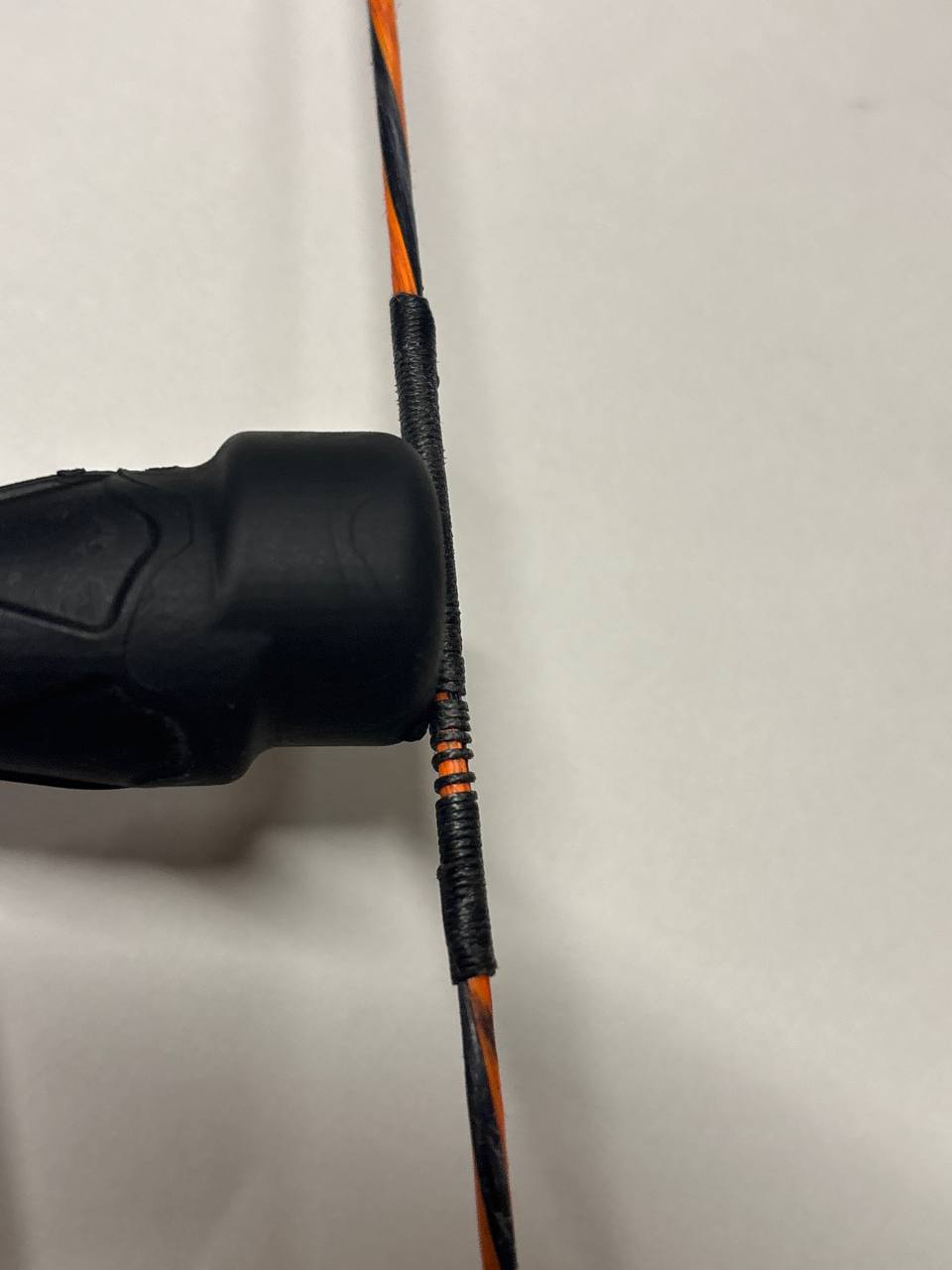
A bowstring has two functional layers. The core strands — typically a high-modulus fiber like BCY 452X, 8125, or similar — carry the load. The serving wraps over the core wherever the string makes contact with something: the cams, the cables, the nock point, the peep, the D-loop anchor. Serving protects the core from abrasion. It wears so the core does not have to.
This is the design working as intended. Serving is a consumable. Core strands are not — at least not on the same timeline. When serving starts to show wear, the appropriate question is not "does this string need replacing?" but "are the core strands still sound?"
What serving wear actually looks like
Serving wear shows up in a few ways. Center serving — the section the nock contacts on every shot — is the highest-wear area. It frays, develops a groove where the nock indexes, or begins to separate from the core strands, leaving gaps where the underlying fibers are exposed. End servings where the string contacts the cam can fray or unravel at the edges.
None of these conditions by themselves mean the string is done. They mean the serving is done.
Evaluating the core strands
Before committing to a re-serve, the core strands need to be assessed in the affected area. Gently separate the serving that remains and look at the strands underneath. You are looking for:
- Fraying or broken individual fibers — a few broken fibers in a high-traffic area are manageable; widespread fraying is not
- Flat spots or crushing — from a nock that was too tight or cam contact over time; if the strands are significantly deformed, the cross-section geometry is compromised
- Discoloration or heat damage — uncommon, but relevant near cam contact areas on high-draw-weight setups
- Separation between strand bundles — the strands should be consolidated and parallel; significant gaps indicate the string is past its service life
If the core strands are intact and look clean under the worn serving, re-serving is the right call. If the strands show damage, the string needs replacement regardless of what you do to the serving.
Serving cannot be repaired — only replaced
This is worth stating plainly, because the instinct when something is worn is to patch it. There is no patch for serving. You cannot add material to a frayed section and restore its function. You cannot splice two serving ends together cleanly enough to hold. The only repair is complete removal of the old serving in the affected area and application of new serving from a clean start point.
Partial re-serves — removing only the worn center section and re-serving from one end of existing serving to the other — are standard practice and work well, provided the transition points are anchored securely and the existing serving on either side is still in good condition. Do not try to re-serve over damaged serving or serve on top of frayed edges. Start and end at clean, tight material.
What the re-serve accomplishes
A correctly applied replacement serving restores the string to full function in that area. The core strands continue their service life. The bow returns to its tuned configuration — assuming the new serving is applied at the same diameter and tension as the original, which matters for nock fit and peep position. If you are re-serving the center, match the original serving thread weight and tension as closely as possible. A significantly fatter or thinner serving changes nock fit, which changes release characteristics, which affects tune.
When re-serving is not the answer
Re-serving makes sense when the string is otherwise performing correctly — holding tune, correct length, no unusual stretch or creep — and the wear is localized to the serving. It does not make sense when the string has stretched significantly beyond its original length, when the core shows real damage, or when the string has been on the bow long enough that fatigue is a reasonable concern regardless of visible condition. A quality string that has been maintained, waxed consistently, and run at appropriate draw weight has a long service life. One that has been neglected, shot dry, or run at excessive weight may look fine and still be near end of life.
When in doubt, a bowyer or string builder can assess the core condition more thoroughly than a visual inspection alone. The cost of that conversation is much lower than a string failure at full draw.