The convention in archery is simple: shoot from your dominant side. Right-handed archers hold the bow in their left hand and draw with their right. This assignment comes from traditional archery, where the draw — a high-force, dynamic, repeated movement — was the natural job for the stronger, more capable arm. The bow arm was a relatively passive support. Convention has not meaningfully changed since.
The question examined here is whether that assignment still makes sense for a modern compound archer — whether putting the dominant hand on the draw and the non-dominant hand on the bow is the optimal neuromotor arrangement, or whether the compound bow's mechanics have made convention functionally backwards.
What each arm actually does
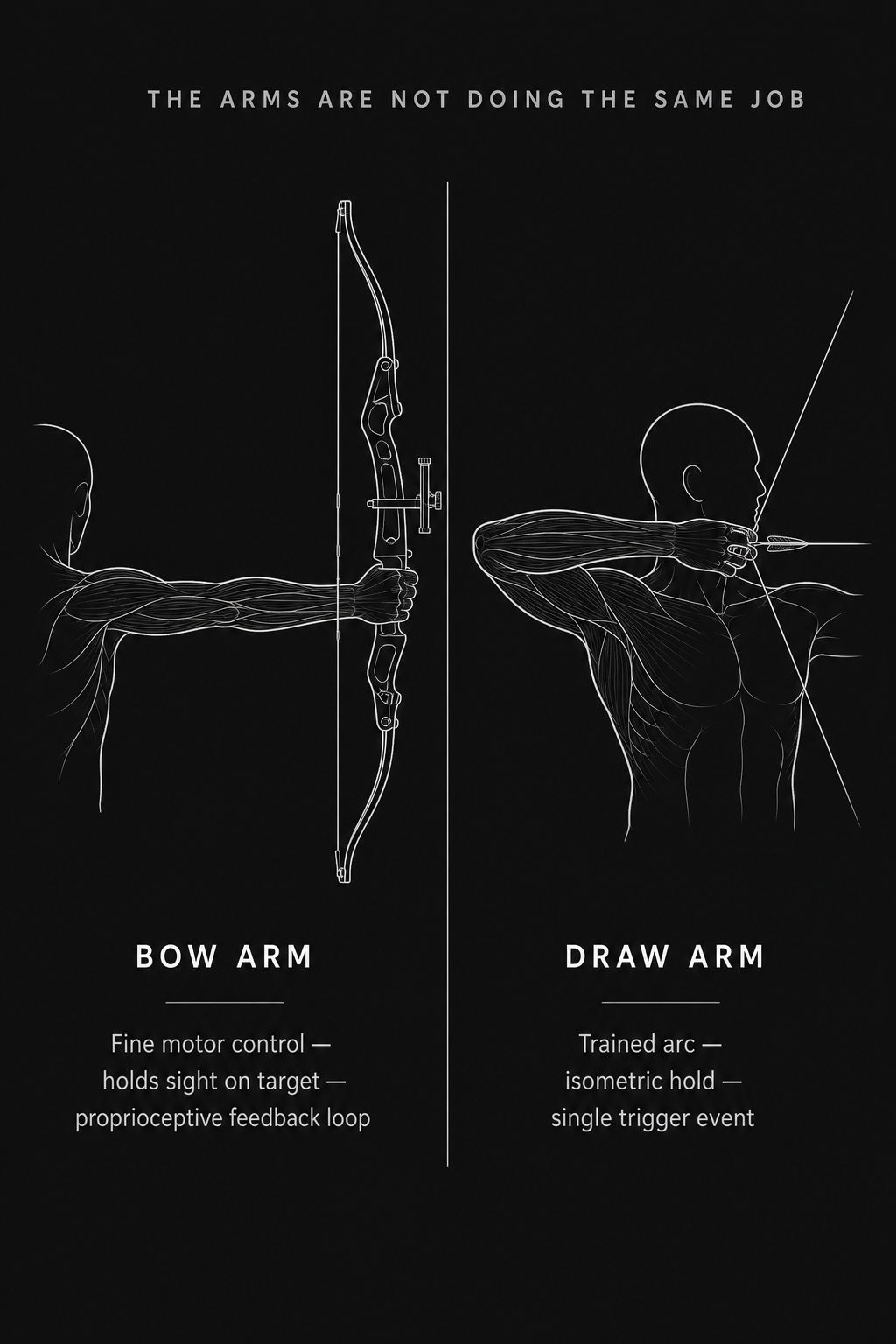
On a compound bow, the two arms perform fundamentally different tasks.
The draw arm pulls the string from brace height to full draw — a high-force dynamic movement that covers a defined arc. At full draw, it holds the release aid against the back wall in an isometric position. When the shot executes, it activates the release: a single trigger event, accomplished with a wrist strap, thumb button, or back-tension mechanism. The movement is practiced until it is a fixed motor pattern. The hold is static. The release activation is a simple mechanical event.
The bow arm holds the bow vertical and stationary against the tension of the draw. It manages grip pressure, controls bow cant, and positions the sight aperture on the target throughout the entire aiming window. Its task is predominantly fine positional control — holding a precision sighting system on a specific point in space while under load, for a variable duration, without knowing exactly when the shot will fire.
These are different tasks. They are not mirror versions of the same task.
The Dynamic Dominance Hypothesis
Neuroscientist Robert Sainburg and colleagues at Penn State developed the Dynamic Dominance Hypothesis through a series of studies beginning in the late 1990s. The model proposes that the two arms are not simply stronger and weaker versions of each other, but are neurologically specialized for different types of motor control.
The dominant arm is specialized for predictive control — generating smooth, efficient movement trajectories by anticipating the intersegmental dynamics of the limb. It excels at controlling the path of a movement: fast, fluid, accurate arcs. Research on reaching tasks showed that dominant-arm trajectories were best modeled by a predictive controller optimizing for mechanical work and spatial accuracy.
The non-dominant arm is specialized for impedance control — resisting perturbations and stabilizing final endpoint position. It excels at maintaining a stable position against unpredictable forces. Non-dominant arm trajectories were best modeled by an impedance controller that responded to error rather than predicted dynamics.
Applied conventionally to archery: the dominant arm handles the dynamic pull — trajectory control — while the non-dominant arm holds the bow stable — a stabilization task. On this reading, convention aligns with the Dynamic Dominance model.
But this interpretation assumes the critical variable in a compound shot is the draw arc, not the aiming hold. That assumption deserves examination.
Where the compound bow complicates the model
An experienced compound archer does not require sophisticated real-time trajectory control to draw. The draw arc is a single, trained motor pattern, executed identically thousands of times. The nervous system automates it. The skilled archer is not calculating intersegmental dynamics during the draw — the pattern runs open-loop. The trajectory control advantage of the dominant arm is most valuable when movements are novel, variable, or require online correction. A grooved draw stroke on a familiar bow is none of these things.
At full draw, the dominant arm is performing an isometric hold — which is a stabilization task, neurologically the non-dominant arm's specialty. The bow arm is managing the sight picture — real-time fine positional control performed under variable conditions against a target at distance, with variable muscle fatigue, and uncertain shot timing.
The mechanical release changes the equation further. Before release aids, the fingers releasing a bowstring required precise, coordinated force reduction across multiple digits — a genuinely demanding fine motor event. A modern wrist release or thumb button reduces the release activation to a single trigger depression. The draw hand, in a modern compound setup, performs:
- A dynamic pull — trajectory task, practiced to automaticity
- An isometric back-wall hold — stabilization task
- A trigger activation — a single-joint mechanical event
None of the draw hand's three tasks is particularly demanding of the dominant hand's unique capability. The bow arm, by contrast, is performing the precision work of the shot throughout the aiming window.
Proprioception and fine motor acuity
The dominant hand demonstrates measurably superior proprioceptive acuity — finer sensitivity to joint position, force magnitude, and small positional changes. Studies of precision grip tasks, finger force coordination, and multi-joint position matching consistently show dominant-hand advantages in tasks requiring small, controlled adjustments under sensory feedback.
In archery, tremor in the bow arm appears directly in the sight picture as pin movement. The precision task of holding the aperture still is executed through fine motor control of the bow hand grip and wrist — the amount of force, the distribution across the grip, the micro-adjustments that resist tremor and fatigue. The dominant hand's superior proprioceptive feedback loop is the most direct mechanism by which aiming precision is maintained.
Convention places the less capable hand on the precision task. This is not an argument made anywhere in the literature — it is simply what convention does, carried forward without reexamination.
Eye dominance
Human visual processing is lateralized: one eye leads in sighting tasks and is preferentially weighted in binocular fusion. Ocular dominance correlates with handedness but is not identical to it.
Approximately 74% of the population shares dominant eye and dominant hand on the same side — right-eye right-hand or left-eye left-hand. The remaining ~26% are cross-dominant. Estimates vary by measurement method and population; a figure cited in Shooting Illustrated placed cross-dominance in target sports at approximately 18%. The consistent finding across studies is that cross-dominance is common enough to be the expected baseline for a substantial fraction of archers, not an edge case.
For a compound archer with a peep sight and scope aperture, the dominant eye must align with the aiming system to produce an accurate and stable sight picture. The dominant eye leads spatial orientation. Using the non-dominant eye to aim introduces a consistent angular offset — the nervous system is trying to aim through the eye it does not primarily use for spatial tasks.
A cross-dominant archer (right-handed, left-eye dominant) using a conventional right-hand bow has three options:
- Force the non-dominant right eye to align with the peep — mechanically possible, neurologically inefficient
- Close or blur the dominant left eye — suppresses the best visual resource available to the archer
- Switch to a left-hand bow — aligns the dominant eye with the aiming system
The third option is the only one that puts the dominant visual system in its natural role. It also, as a byproduct, places the dominant hand on the bow arm.
What the archery-specific research shows
A study examining the interaction of hand preference and eye dominance on accuracy in archery found that uncrossed patterns — matching eye and hand on the same side, the conventional arrangement — produced better accuracy in novice archers shooting without sights. Critically, the use of mechanical sights reduced the measured accuracy difference between matched and cross-dominant archers. The authors concluded that the mechanical sight system partially compensates for the neural integration deficit in cross-dominant archers who have not switched sides.
Partially compensates is not fully compensates. The attenuation of the effect with sights does not eliminate it. The study also measured archers in whatever their habitual configuration happened to be — not archers optimally configured and trained for their dominant-eye side. It does not measure what a cross-dominant archer who has fully trained to their dominant-eye setup can achieve.
The EMG literature on archery (Clarys et al., 1988, 1990; Hennessy and Parker, 1990; Martin et al., 1990) documents that muscle activation patterns differ substantially between draw arm and bow arm throughout the shot cycle — confirming that the two arms perform fundamentally different tasks and are loaded asymmetrically. This work establishes the functional asymmetry as significant and measurable. It does not address which hand should be on which side.
Dynamical analyses of elite archers versus novices (Quel de Oliveira et al., 2023, PMC) found that expert archers show tighter, finer, and more fluid control of both the bow hand and the drawing hand — with distinct control signatures on each side. The elite bow hand is more controlled, not just more stable. This is consistent with the fine-motor-precision argument for the bow arm, though the study does not directly address laterality.
The explicit gap in the literature: no controlled study has compared the performance of cross-dominant compound archers who shoot conventional-side versus dominant-eye-side configurations with matched training time. The specific question of whether a dominant-hand bow arm produces measurable accuracy advantages in compound archery has not been formally tested.
The argument for the conventional setup
The conventional arrangement has a coherent mechanical argument. The draw is the high-force dynamic movement, and the dominant arm handles dynamic movements more smoothly and efficiently under the Dynamic Dominance model. A dominant-arm draw arc should, in principle, be more consistent in trajectory and less variable in timing than a non-dominant-arm draw arc — at least in early training.
The non-dominant arm's impedance control advantage can also be read as what the bow arm needs: holding position against the constant perturbation of draw tension, resisting the load without over-correcting.
These arguments are internally consistent. They assume the critical source of shot variability is the draw arc, and that the bow arm's job is primarily gross stabilization rather than fine positional precision. Neither assumption maps cleanly onto an experienced compound archer using a well-fitted release. The draw arc becomes automated. The aiming hold remains variable. The impedance-control argument for the bow arm's non-dominant assignment does not account for the fine motor demands of holding a sight aperture on a precise point through a variable aiming window.
Working conclusion
For cross-dominant archers, the neuromotor and visual arguments both point in the same direction: shoot to the dominant-eye side. This places the dominant eye in its natural sighting role, and places the dominant hand on the bow arm — the arm doing the precision work. The case does not depend on a single argument. It holds from the eye side and from the motor control side independently.
For archers who are not cross-dominant — right-hand, right-eye or left-hand, left-eye — the eye alignment question does not force a choice. The fine-motor-bow-arm argument still applies, but the visual cost of the conventional setup is absent. Whether the proprioceptive and fine-motor advantages of a dominant-side bow arm outweigh the draw-arc consistency advantages of a dominant-side draw remains an open empirical question for this population.
What the evidence supports across both groups: the compound bow with a mechanical release has substantially changed the task demands of both arms relative to the bow that produced the convention. The draw hand's role has been simplified by the release aid. The bow arm's role has been made more demanding by the precision sighting system. The original neuromotor justification for the dominant-hand draw — that the draw is the technically demanding, high-skill task requiring the capable arm — is weaker in compound archery than it was when the convention was established.
References
Sainburg, R.L. (2002). Evidence for a dynamic-dominance model of handedness. Experimental Brain Research 142(2):241–258.
Sainburg, R.L. & Kalakanis, D. (2000). Differences in control of limb dynamics during dominant and nondominant arm reaching. Journal of Neurophysiology 83(5):2661–2675.
Schaefer, S.Y., Haaland, K.Y., & Sainburg, R.L. (2007). Ipsilesional motor deficits following stroke reflect hemispheric specializations for movement control. Brain 130(8):2146–2158.
Clarys, J.P. et al. (1988, 1990). EMG studies of sport archery. Journal of Sports Sciences.
Hennessy, M.P. & Parker, A.W. (1990). Electromyography of arrow release in archery. Electromyography and Clinical Neurophysiology 30(1):7–17.
Quel de Oliveira, C. et al. (2023). Dynamical analyses show that professional archers exhibit tighter, finer and more fluid dynamical control than neophytes. PLOS ONE. PMC10606362.
Interaction of Hand Preference with Eye Dominance on Accuracy in Archery. ResearchGate publication 26309579.
Published 2026-07-08 · Axial Bowstrings