A stabilizer is mass. That is the complete mechanical definition. A rod extending from the riser, with weights at the end — the rod is leverage, the weights are mass. Manufacturers include the mounting thread on every compound bow they produce and provide no guidance on what to attach to it. That gap between universal inclusion and zero specification is where most of the confusion about stabilizers begins and stays.
The mass serves two purposes. The primary one is balance — positioning weight to bring the bow's resting tendency into a stable, predictable state. The secondary one, and the more mechanically significant, is inertia during the shot.
Vibration damping — useful but overstated
The primary marketing pitch for stabilizers over the last two decades has been vibration damping — how dead the bow feels at the shot. Vibration reduction is real and it is genuinely pleasant. It is also the least important thing a stabilizer does for accuracy.
In high-speed video, the arrow is already ten yards in front of the bow by the time the shock of the shot reaches the archer's hand. The vibration you feel — the ring, the kick, the residual movement — arrives after the arrow has left. Damping it does not change what the arrow experienced during the shot. The mechanical work the stabilizer does for the arrow happens in the milliseconds before that vibration reaches you.
That does not mean vibration damping is worthless. A bow that rings and kicks is unpleasant to shoot, and unpleasant equipment reduces the mental ease that good aiming requires. Comfort is a legitimate performance input. But it is downstream of the primary mechanical job — inertia during the shot — and buying a stabilizer primarily for its damping characteristics while ignoring rod stiffness, mass placement, and total weight is optimizing the secondary effect at the expense of the primary one.
Rod stiffness — the component most archers ignore
A stabilizer rod that flexes under load undermines the weight it carries. If the rod bends when the bow is disturbed, the bow moves through the flex range of the rod before the mass at the end can resist that movement. By the time the mass engages, the bow has already rotated — and the arrow may be gone. A limber rod is a delayed-action system. The weight only matters after the flex has been used up.
A practical test: grip the rod at each end and apply gentle bending pressure. Any flex you can feel through your hands is flex that will be used up before the weight resists rotation. The best rods feel like bending a steel bar — the deflection under hand pressure is essentially zero. The rod should transmit the inertial load from the weights to the bow instantaneously, not after the flex has been taken up.
The same principle applies to the connection between weight and rod. Rubber isolators and vibration-damping modules between the mass and the rod make the bow feel better. They also introduce compliance into the system — the weight can shift slightly before the rod transmits it. For the primary inertial job, a rigid connection between weight and rod is more effective. If you are running damping hardware between your weights and the rod specifically for feel, be aware that the tradeoff exists.
The pin float effect
Extend your arm and use your fingertip as an aiming point on a target at distance. The movement is chaotic — small circles that shift direction unpredictably, every tremor visible, the pattern random. Now hold a 4- or 5-pound weight in that hand, still extended. The movement is still there, but the character changes. The circles slow. The pattern becomes more predictable — approaching an ellipse rather than a random walk. The tremor is the same; the expression of the tremor has changed.
That is stabilizer mass reducing pin float. The weight does not eliminate the tremor or the muscle fatigue producing it. It slows the angular expression of the tremor — the same forces, applied to a more massive system, produce smaller and more gradual angular changes per unit time. Most archers describe the entire stabilizer effect in these terms: it slows the pin.
That description is accurate. It is also incomplete.
Inertia during the shot
The more important effect of stabilizer mass is not what it does while the archer is aiming — it is what it does during the shot execution, from the moment the release fires until the arrow clears the string.
Any movement introduced in that window — grip twist, hand spasm, a muscle releasing early — is communicated to the arrow. The stabilizer system does not prevent those errors. It reduces their output by increasing the bow's resistance to angular acceleration.
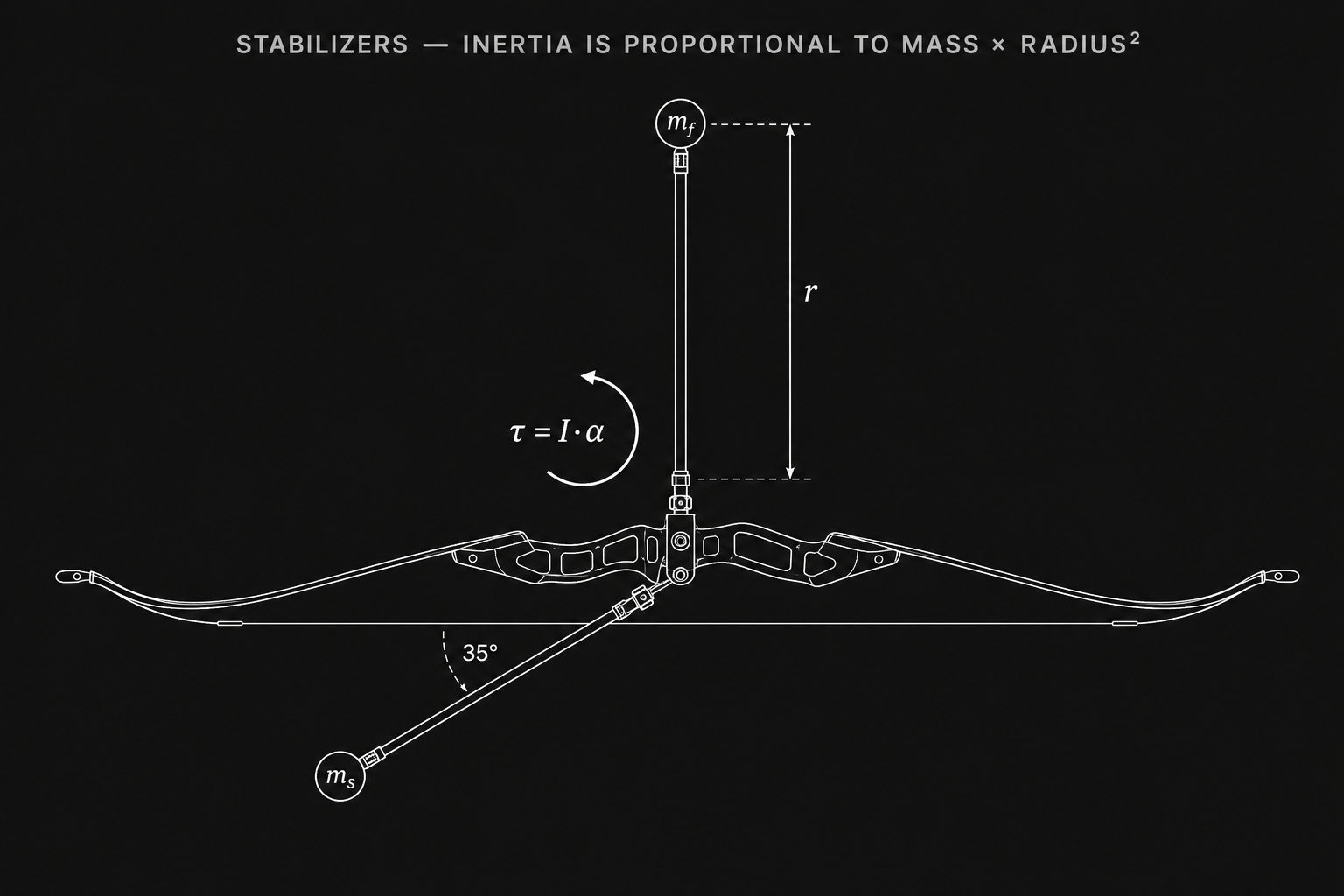
The governing rule is Newton's second law applied to rotation. In plain terms: for a given twisting force, the resistance to being twisted equals the weight multiplied by the square of its distance from the pivot. Same weight, twice as far out, four times the resistance to being twisted. Three times as far out, nine times the resistance. The distance is doing the heavy lifting.
That is why a 4-ounce weight at the end of a 30-inch front bar does far more work than the same 4 ounces packed close to the riser grip. Move mass away from the pivot and its ability to resist twist multiplies by the square of how far you moved it. A 4-ounce weight at 30 inches out resists twist about 9 times more than the same 4 ounces at 10 inches out — same total weight, same total ounces on the scale, three times the arm, nine times the effect.
Now bring in the error. When a grip twist or hand spasm applies a small twisting force during the shot, the bow's rotation from that force is inversely proportional to its resistance. Double the resistance and the bow rotates half as much in the milliseconds the arrow is still on the string. That is the entire mechanism.
This is the real value of stabilizer weight. Not the pin float — the shot execution. The arrow is on the string for only a few milliseconds after the release fires. What the bow does in those milliseconds is what the stabilizer is actually managing.
The aiming trade-off
There is a limit to how useful this is, and most compound archers significantly exceed it.
Aiming consists of two separate tasks: getting the sight on target and holding the sight on target. In speed precision shooting — handgun competition, for example — the first task dominates. Rapid target acquisition is the entire game. In archery, the second task dominates. There is no time constraint on acquisition; the hold is where the score is made. Stabilizer mass helps the hold and actively hurts the acquisition.
The pistol-versus-rifle analogy makes this concrete. A pistol moves easily and quickly — swing it to a target, it responds. Holding it absolutely still for a precision shot at distance is difficult; every small force moves it. A rifle is slow to swing. Getting a rifle from a standing position onto a small target under pressure is work — the mass that resists wobble also resists movement. But once on the precision target, the hold is vastly superior. The same mass that makes aiming difficult makes holding possible.
Archery rightly leans toward the rifle end: there is no time pressure, and the hold matters more than the acquisition speed. But you can move so far toward the rifle end that getting the sight onto the target becomes a struggle in itself — and a perfect hold on a target you could not acquire is worth nothing. The aiming fails before the holding begins.
The practical ceiling of useful stabilizer weight is lower than most archers assume, and it is lower still late in a shooting session when the muscles holding that weight are fatigued.
The weight myth — a practical observation
A common pattern in long practice sessions illustrates this directly. After 60 or more shots at 70 pounds, with a typical target setup — 5 ounces on the front bar, 10 ounces on the rear — the bow begins to fight you. Getting the sight onto the bull becomes effortful. The pin is hard to place. Something that should be mechanical starts to feel like a struggle against the bow, not with it.
Remove the stabilizers entirely and shoot a few ends. The effect is often surprising: the sight moves easily to the target, settles there cleanly, and stays. The bow is technically less mechanically supported against error — and the score is better.
What is happening: the stabilizer mass that was supposed to improve the shot has exceeded the archer's available holding strength at that point in the session. The muscles are no longer winning against the weight. The tremor and fatigue that the mass was meant to absorb are now expressed because of the mass — the bow requires more effort to hold in space than the archer can cleanly provide. Remove the weight and the remaining muscle capacity is sufficient. The aiming works because the system is no longer fighting the archer's arm.
The mathematical case for more stabilizer mass is internally consistent. The problem is that the archer carrying that mass is not a constant. Fatigue is real. The optimal stabilizer weight is not the weight that performs best at shot one — it is the weight that still performs at shot sixty.
What almost no archer does — and what the logic above points toward directly — is treat stabilizer weight as a variable rather than a constant. The optimal weight is not the same at shot one as it is at shot sixty, and it is not the same in a morning practice session as it is in the final elimination end of a tournament when accumulated fatigue is real. Removing an ounce or two from the front bar between the practice period and the first competitive end is a legitimate edge. A heavier setup through warm-up loads the hold muscles; a slightly lighter setup when it counts gives those muscles back their margin. This is the same principle as the batting donut in baseball — the contrast effect of swinging a heavier implement before the real performance — applied to bow weight rather than draw weight. The placement matters: weight added near the riser end of the front stabilizer contributes almost nothing to rotational MOI, so it does not disturb the tuned balance of the system. It changes only the raw hold weight in hand, which is exactly the variable fatigue affects. Remove it and the bow moves more easily, the sight settles faster, and the hold feels cleaner — not because anything about the bow changed, but because the muscles are no longer overloaded by the mass they were carrying a few minutes earlier.
Balance — two planes, not one
Stabilizer weight does two distinct things for bow balance, and most archers think only about the first.
The first is the forward–rearward torque balance. The front bar pulls the bow forward; the side rod and rear bars pull it back. The math is simple: for each bar, multiply the weight in ounces by the length in inches. That number — inch-ounces — is how hard that bar is pulling. As a starting point, front pull and rear pull should be roughly equal.
The second balance effect is less often discussed: lowering the center of gravity of the entire bow system. A bow whose center of gravity is below the grip axis sits in a stable resting position naturally — the valley model described in the Bias article. It does not want to cant left or right without being pushed. That low-CoG stability reduces the lateral variation in bow cant that the archer has to actively manage between shots.
Most archers agree that a slight lateral bias is beneficial — the bow consistently wanting to fall in one direction rather than being neutrally balanced in all directions. This is an intentional design choice in stabilizer setup, not an accident to be corrected.
What elite setups reveal
The balance formula above — front moment roughly equal to rear moment — is a useful starting point. Some of the best compound archers in the world deliberately ignore it.
Mike Schloesser, the 2026 Vegas Shoot champion, runs as much as 36 ounces on his front bar and only around 34 ounces on a single rear bar. He also adds weight directly to the bow. On paper the stabilizer balance looks wrong — the front moment is over 1,000 inch-ounces while the rear bar contributes perhaps 340. The bow is dramatically front-dominant. This is not a setup error. It is a considered choice, and the physics behind it tells you something the balance formula leaves out.
The distinction starts with what each bar is actually doing. The front bar is for stability — inertia during the shot. The rear bars are for balance — attitude adjustment in the forward-rearward and lateral planes. Those are different jobs. They do not need to be in a fixed ratio to each other.
The second thing the balance formula leaves out is where the true pivot point is. Most discussions treat the grip as the pivot: weight in front of the grip pulls the bow forward, weight behind pulls it back. But the real pivot of the entire system is the shoulder. The bow arm is a lever anchored at the shoulder joint, and the entire bow-plus-stabilizer assembly rotates around that point during the shot.
From a shoulder pivot, the inertia calculation changes. The front bar sits at maximum distance from the shoulder — arm length plus rod length — contributing maximum resistance to twist. The rear bar sits behind the grip, at arm length minus rod length from the shoulder. Shorter moment arm, less inertia per ounce. By the same math that makes end-weighted long rods more effective than stubby ones, the rear bar is at a geometric disadvantage — and so is any weight hung behind the grip compared to weight placed on the bow itself.
This is the counterintuitive result: weight added to the bow — to the riser, anywhere near the grip — contributes more inertia from the shoulder pivot than the same weight on a rear bar. The rear bar mass is actually closer to the shoulder than the bow body is. Weight on the bow puts mass at near-maximum moment arm from the shoulder; weight on a rear bar shortens that arm.
Schloesser's front-heavy setup is not breaking the rules. It is applying a more complete version of them: heavy front bar for inertia, minimal rear weight for attitude tuning, and no obligation to chase a numerical balance between the two. The rear weight is doing exactly what it needs to do — and no more.
Follow this logic to its conclusion and the rear bar nearly eliminates itself. If its only mechanical job is attitude adjustment, and that adjustment can be done with less weight at greater efficiency by adding mass to the bow itself, then the rear bar's case comes down almost entirely to feel. Most archers with significant time behind a bow develop a strong sense of how it should sit in the hand, and rear bar weight contributes to that sensation in ways that are real even if they are difficult to quantify. That is a legitimate reason to run one. It is just not the reason most archers think they are running it.
The proportion myth
One persistent idea in compound archery is that the holding weight of the bow and its physical weight must be in a fixed proportion — a heavier bow requires heavier holding force, or the other way around. The logic sounds reasonable. The math does not support a hard rule.
A compound bow at full draw is not held vertically against gravity by the bow arm alone. The support is triangular: the drawing arm pulls the string, which puts tension through the cables and cams back against the archer's bow hand, which loads the bow arm in tension rather than pure vertical compression. The forces distribute across that triangle. How much physical bow weight the bow arm must support in isolation depends on the specific geometry, the anchor, and the shoulder position — not on a simple proportion of holding weight to bow weight.
This matters because archers use the proportion argument to justify increasingly heavy stabilizer setups at increasing draw weights. The argument doesn't hold. The correct question is whether the archer can hold the bow correctly in the shooting position through a full session — not whether the ratio hits a target number.
Starting points for new archers
In the first year of tournament archery, stabilizer placement and selection matters — it will make a measurable difference in your shooting. But your preferences cannot emerge until you have shot enough to develop them. Guessing at those preferences before you have the data is just buying and moving weights.
Start with an adjustable quick-disconnect and a basic front stabilizer at minimal weight. Shoot. Over time, specific things will start to bother you: the bow wobbles left and right and you want a lower center of gravity; you want 8 degrees of downward angle on the front bar; you want zero degrees on the disconnect; you want to add a side rod for lateral bias. Those preferences are real — they come from shooting, not from spec sheets.
George Ryals IV wrote an excellent piece on stabilizer balance and the mechanics of MOI worth reading alongside this one: Stabilizers, Balance, and Bows — Archery Learning Center.
Published 2026-07-08 · Axial Bowstrings