
The short answer
A modern compound bowstring built from a good high-modulus material — SK75, SK99, BCY-X, 452X — is done at somewhere between 3,000 and 5,000 shots, or two to three years from install, whichever comes first. That is not a rule. It is the center of a range. The rest of this article is about what moves an archer inside that range, and what pulls them out of it in either direction.
What a worn string actually looks like
Wear on a bowstring is a set of specific, visible changes. If an archer knows what to look for, none of them require guesswork.
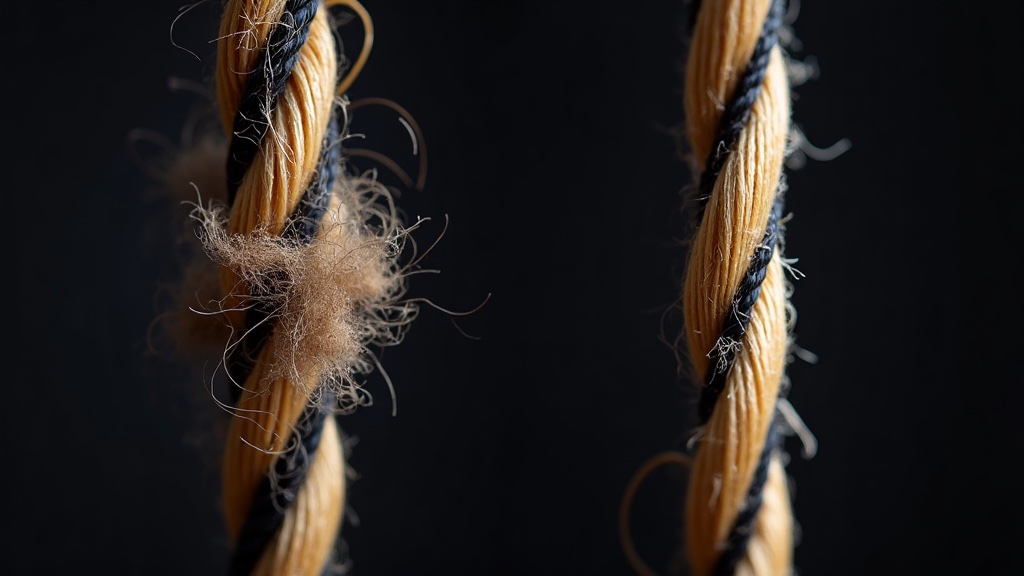
Fuzzing along the string bundle. Individual filaments break at random locations along the string over time. A new string is smooth and glossy under wax. A used string develops a soft halo of broken filament ends along its length. Some fuzz is normal — a string with zero fuzz after 500 shots is a string that has been recently waxed rather than a string that is new. Fuzz becomes a replacement signal when it is dense enough that you can feel it as a distinct texture running your fingers along the string, or when strands are visibly separating from the bundle rather than sitting inside it.
Serving separation. The center serving and the end servings are the highest-wear points on the string. The center serving takes every release, and the end servings sit inside the cam grooves and bear against the axle geometry every draw cycle. Separation shows up as small gaps opening between adjacent wraps, or as the serving sliding along the string axis and exposing bare bundle underneath. A string with a slipping center serving is done. Re-serving is possible but rarely worth the effort — the underlying bundle has usually run out of usable life at the same time the serving has.
Cam-side wear pattern. Look at the string where it seats into the cam groove at full brace. On a well-tuned bow this contact zone should look identical shot to shot — a slight sheen where the string contacts the cam. If you see a distinctly worn, fuzzed, or flattened region there, the string has been running through a rough spot in the cam or against a burr. The string is wearing faster than it should, and the underlying cause needs to be found before the next string is installed. Replacing the string without fixing the cause just resets the same wear clock.
Peep rotation drift. A string that has finished stretching sits at a stable peep rotation. A string that is still stretching, or a string that has developed inconsistent stretch across its length, will show a peep rotation that changes shot to shot or session to session — the archer finds themselves twisting the string to bring the peep back to alignment more often than every few months. Persistent peep rotation drift on a string past its early stretch phase (say, past shot 500) is a signal the string is failing, not seating.
Loss of peak weight or brace height. A string that has stretched beyond its ability to be tuned back to spec will show up as a bow that measures short on peak weight, brace height, or ATA. This is the least visible failure mode and the one archers miss most often. It shows up as a sudden or slow drop in arrow speed, or as a group that has moved on the target with no obvious equipment change. Check the bow specs against the manufacturer's numbers. If they are drifting and can no longer be twisted or torqued back to spec, the string is done regardless of what it looks like.
Visible strand damage. A single cut or nicked strand from a fletching contact, a broadhead, or an accidental brush against something abrasive is a replace-now condition. A bowstring holds a large load at draw. A compromised strand does not fail predictably.
The rough numbers
Numbers on a bowstring's life are always ranges, because the underlying variable is stress cycles under specific conditions, not a single count of shots. But the ranges are narrow enough to plan around.
- Elite indoor / target archer shooting a fixed indoor round three times a week, warm room, clean environment: 4,000 to 5,000 shots per string. Two years of use is easy; three years is possible if the string is well cared for. This is the top of the range.
- Serious 3D and outdoor competitor shooting outdoors regularly, exposed to sun and weather, occasional dust and moisture: 3,000 to 4,000 shots per string. Two years is the realistic upper bound. Sun exposure is the biggest single accelerator here.
- Recreational archer shooting a few times a month, mixed indoor and outdoor, no aggressive schedule: shot count almost never reaches the failure threshold; the string times out on age instead. Three years is a reasonable planned interval. Longer than that and the material is losing its properties even if the visible wear looks fine.
- Bowhunter shooting a small number of practice shots each week and one or two shots at game per season: shot count is trivially low. The string ages out at 2 to 3 years from install, dominated by weather and UV exposure rather than by draw cycles.
The 3,000–5,000 shot band is not a specification — it is what a properly built modern high-modulus string does before its stretch, its wear, and its consistency drift out of the range where a well-tuned bow stays well-tuned. Some strings last longer. Some go earlier. Neither is a defect. Both are inside the range the material allows.
What shortens the timeline
UV exposure. Polyethylene fibers — the base material of every modern bowstring — degrade under ultraviolet light. Sunlight breaks the polymer chains at the molecular level. An outdoor archer whose bow lives on a stand in the sun between shots is running a much faster clock than a target archer whose bow lives in a case between rounds. UV damage is invisible until the string fails prematurely on a set of otherwise clean shots. Rule of thumb: a string that spends significant unshielded time in direct sun ages roughly twice as fast as a string that is kept in a case or under a shaded stand.
Humidity swings and moisture cycles. Wet strings expand slightly. Dry strings contract slightly. A string that sees repeated wet-dry cycles — outdoor archery in a rainy climate, or a bow that lives in a hot truck cab in the summer and a cold garage in the winter — accumulates micro-stress at every cycle. The string does not fail from moisture. It fails from the geometric changes that come with each cycle.
Insufficient wax. Wax is not a lubricant. It is a barrier that keeps the strands moving smoothly against each other under load and blocks moisture from wicking into the bundle. A neglected string wears roughly twice as fast as a properly waxed one because the strands abrade against each other every draw cycle. This is the single biggest lever the archer has over string life.
Over-waxing or wrong wax. The counter-lever. A silicone-based conditioner or an over-waxed string traps grit inside the bundle, and the trapped grit acts as an abrasive from the inside. This is a slower failure mode than under-waxing, but it shows up as premature fuzzing on a string the archer thought they were taking good care of. See String wax vs. string lube for the distinction.
Rough cam grooves or a burr on the axle. Any manufacturing defect or wear point in the cam that touches the string will accelerate wear at that point. A string that fails cam-side after 1,500 shots on a modern bow is almost always failing because of a cam surface issue, not because the string was defective.
Fletching contact. Vanes that clip the string at launch abrade it in a very specific location. If the archer can see a wear line on the string above the nock point that matches the fletching pattern, the string is being cut with every shot. The tune, not the string, is what needs to change.
Heavy poundage relative to material spec. A string built with a strand count sized for its bow will last inside the normal range. A string undersized for the bow — too few strands of the same material — runs closer to the material's strain limit on every shot and wears proportionally faster. See Strand counts.
What extends the timeline
Consistent, correct waxing. A small amount of the right wax, worked into the bundle by hand, before the string starts looking dry — repeatedly across the string's life. A string treated this way genuinely does last significantly longer than an identical string that gets one heavy wax job every six months.
Case storage between sessions. A string that lives out of direct sun, out of humidity swings, and out of dust ages primarily on stress cycles rather than on environmental cycles. That is the slower failure mode.
Clean bow, clean cams. A cam that is inspected once a season, cleaned of grit, and checked for burrs runs the string through a smooth path every shot. The string sees only the wear the material is meant to see.
Higher strand count within reason. More strands means each strand sees a smaller share of the load, and the bundle wears more slowly. This has diminishing returns — past a point, extra strands add speed loss and hand shock without buying meaningful life — but a bow that is on the lean side of its strand-count recommendation will not achieve the top of the life range no matter how well the archer cares for it.
The Axial position
The purpose of a string is to give the bow the same shot every time. The moment the string stops doing that reliably, its useful life is over, whatever the calendar says.
Published 2026-07-09 · Axial Bowstrings